URBADAPT-HEAT
URBADAPT-HEAT v1.0 is the urban heat implementation of the URBADAPT architecture: an open-source geospatial framework for city-level heat risk assessment and public–private adaptation cost-benefit analysis, built on the CLIMADA probabilistic risk engine.
Given a European city, URBADAPT-HEAT:
- Maps the heat hazard at ~100 m resolution using the UrbClim urban climate dataset, for a 2020 baseline and climate projections to 2050 across four CMIP6 scenarios. Two hazard tracks are supported — a standard daily-mean track and an extreme-event (heatwave) track for cool and maritime cities.
- Quantifies heat-attributable mortality with age-stratified exposure and city- and age-specific epidemiological impact functions.
- Evaluates three adaptation pathways — air conditioning, urban street trees, and early warning systems — through their physical mechanisms, and represents the interactions between them.
- Integrates a 25-year discounted cost-benefit analysis including externalities (air conditioning waste heat), co-benefits (vegetation reducing cooling electricity demand), and distributional outcomes across social vulnerability quintiles.
- Identifies cost-effective adaptation portfolios via Pareto-frontier budget optimisation.
At a glance
| Spatial resolution | ~100 m (UrbClim native grid, EPSG:3035) |
| Temporal horizon | 2020 · 2030 · 2040 · 2050 |
| Climate scenarios | CurPol, GS, SP, SSP5-8.5 (CMIP6 ensemble) |
| Demographic scenarios | SSP1–5, SSP2-DM, SSP2-ZM (Wittgenstein Centre) |
| Cities configured | 40+ European functional urban areas |
| Cities demonstrated end-to-end | Rome · Athens · Lisbon · Copenhagen |
| Adaptation pathways | Air conditioning · urban street trees · early warning systems |
| Impact functions | Masselot et al. city- and age-specific (main); Burke et al. (sensitivity) |
| Risk engine | CLIMADA v6.1.0 |
| Configuration | One city-specific YAML file per city |
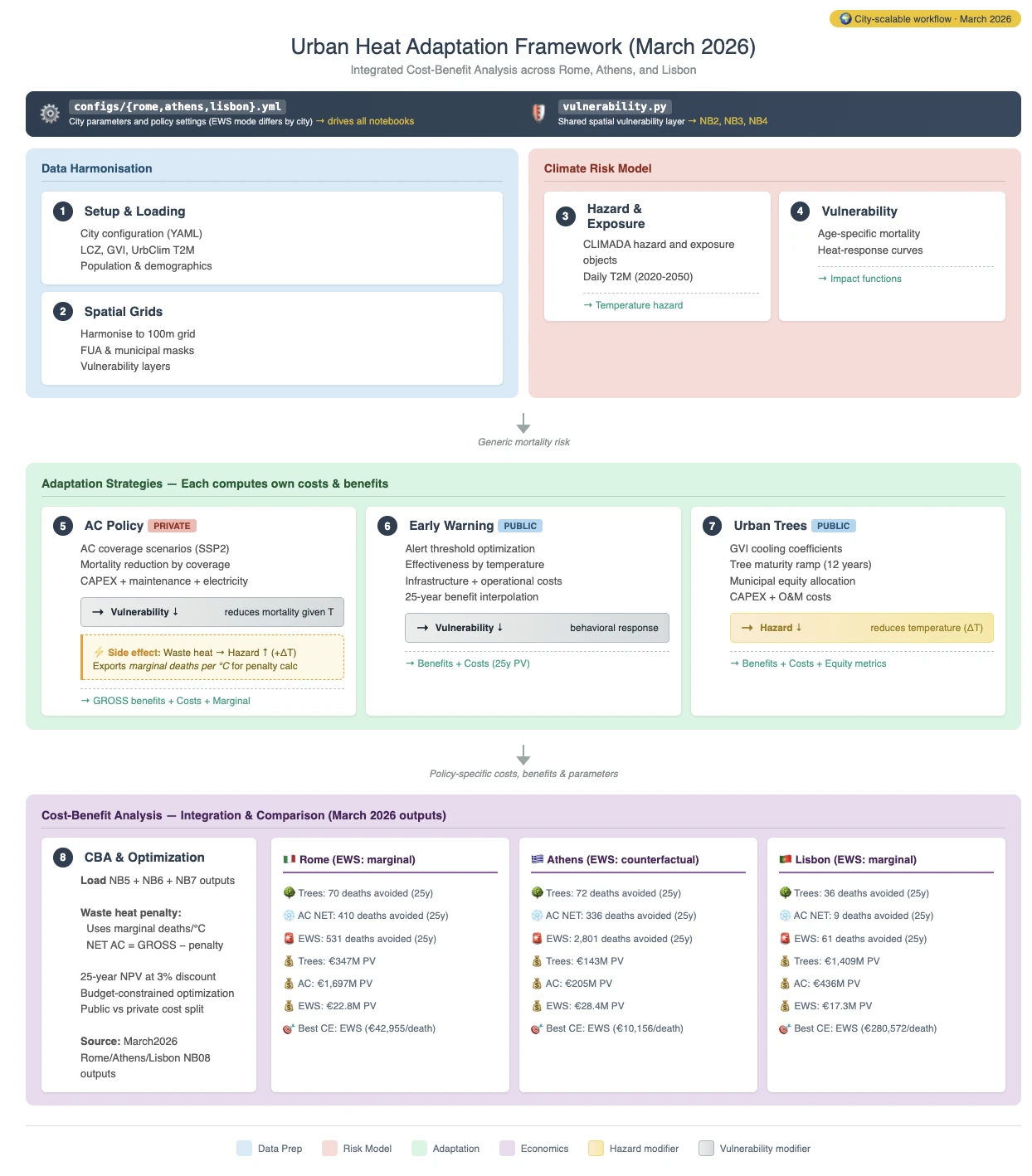
The URBADAPT-HEAT pipeline. Ten numbered notebooks carry a city from raw UrbClim climate fields and WorldPop demographics through hazard, exposure and vulnerability construction, impact modelling, adaptation-pathway simulation, and a 25-year discounted cost-benefit analysis to a Pareto-optimal portfolio.
Quick start
URBADAPT-HEAT runs on Python 3.10 in a dedicated conda environment:
git clone https://github.com/URBADAPT/URBADAPT-HEAT.git
cd URBADAPT-HEAT
conda env create -f urban-heat/environment.yml
conda activate urbanheat
pip install -e urban-heat          # installs the cityheat helper package
jupyter-lab urban-heat/notebooks   # open the notebook pipeline
The analysis runs as ten numbered notebooks (01_setup → 10_summary). They are
city-agnostic: select a city with a single line near the top of notebook 01, then
run 01 → 10 in order.
See Installation & usage for the full walkthrough, including data sync and the one-click Windows launcher, and City configuration for how to add a new city.
Documentation
| Page | Description |
|---|---|
| Installation & usage | Setup, dependencies, data sync, running the notebook pipeline |
| Framework overview | Architecture, pipeline structure, spatial domain |
| Hazard | UrbClim T2M fields, synthetic baseline, climate deltas |
| Exposure | Age-stratified population, WorldPop, demographic projections |
| Vulnerability | Social Vulnerability Index, dynamic projection |
| Impact functions | Age-specific heat-mortality dose-response curves |
| Adaptation pathways | Air conditioning, street trees, early warning systems |
| Cost-benefit analysis | 25-year CBA, interactions, budget optimisation |
| Uncertainty analysis | Structural, climate, and parametric sensitivity |
| City configuration | Configuring URBADAPT-HEAT for a new city |
| Case studies | Rome, Athens, Lisbon, Copenhagen results |
Data sources
URBADAPT-HEAT builds on openly available datasets and published epidemiology:
| Component | Source |
|---|---|
| Urban climate fields | UrbClim (VITO), ~100 m urban climate dataset |
| Climate projections | CMIP6 ensemble deltas (CurPol, GS, SP, SSP5-8.5) |
| Population | WorldPop gridded population |
| Demographic projections | Wittgenstein Centre Human Capital Data Explorer |
| Impact functions | Masselot et al., city- and age-specific (main); Burke et al. 2025 (sensitivity) |
| Risk engine | CLIMADA v6.1.0 |
Citation
Please cite the framework description when using URBADAPT-HEAT:
Aboudrar-Méda, A. and Falchetta, G.: URBADAPT-HEAT v1.0: a scalable geospatial framework for city-level public–private adaptation infrastructure cost-benefit analysis and its urban heat risk implementation, in preparation, 2026.
@article{aboudrarmeda_urbadapt_heat_2026,
  author  = {Aboudrar-M{\'e}da, Armande and Falchetta, Giacomo},
  title   = {{URBADAPT-HEAT} v1.0: a scalable geospatial framework for
             city-level public--private adaptation infrastructure
             cost-benefit analysis and its urban heat risk implementation},
  year    = {2026},
  note    = {Manuscript in preparation}
}